Barley: Genus Hordeum, family poaceae, a cereal grain.
Of the various cereals, barley has been adapted to the widest variety of climates, from sub-Arctic to sub-tropical. Barley is grown on a wide scale in Russia, Australia, Germany, Turkey and North America. Leading exporters are the European Union, Australia and Canada.
Barley is classified as six-row or two-row, describing the physical arrangement of kernels on the plant. Another classification describes the beards or awns covering the kernels.
Barley Usage
Barley is grown for feed, food, or malting. Barley grown for feed is used in rations for all animal types. Barley is a popular grain throughout parts of the United States where it offers environmental advantages when grown in rotation, or has a clear transportation advantage, such as California. It is a short-season, early maturing crop grown on both irrigated and dry land production areas in the United States.
Though barley's energy is not as easily utilized by animals, it does have a higher protein content than corn, which reduces the need for a protein supplement in a feed compound. Consequently, barley, although grown in smaller quantities, competes with both corn and sorghum as a feed grain in the United States. Most barley in the United States is grown to be malt barley because of the price premium it commands. Historically, livestock consumed most of the barley produced in the United States. This is no longer the case as food and industrial uses have shown continued growth while feed uses of barley have declined. The current breakdown is approximately 68 percent food and industrial use, 5 percent export use and 27 percent feed and residual use.
Barley Utilization:
Barley is popular as a staple food as well, used in soups, as an extender for vegetable proteins and occasionally milled into flour. Most barley used for food is either pearl barley or barley flour. Pearling consists of a polishing process, which removes the outer husk and part of the bran layer of the kernels. Barley flour, a by-product of pearling, is used in the United States for baby foods and other specialties. Barley as flatbread or porridge is widely consumed in North Africa and parts of Asia.
In addition to traditional 2-row and 6-row barley, hull-less barley varieties have been developed for food application, where a minimal amount of cleaning is required prior to processing. Barley has nutritional advantages such as high fiber and antioxidant content, as well as being cholesterol free and low in fat. A number of current and ongoing research studies are concentrating on the potential health benefits of barley. Initial results in the lowering of blood cholesterol are promising, but additional studies are necessary to confirm results.
When barley is used for malt, it involves steeping malting barley in water, under controlled conditions, allowing it to germinate or sprout, at which stage it is known as green malt. It is then dried or roasted in a kiln, cleaned, and stored for extended periods. Malt by-products such as screenings and sprouts are separated and used as animal feed. Malt is primarily an intermediate product and requires further processing. Most of malt production is used to produce beer. To a small extent, malt is used by the distilling industry in the production of hard liquors such as whiskey, and by the food industry in the production of some cake mixes and breads.
The production of malt beverages in the United States has stabilized over the past decade. In 2002, the United States produced 6.2 billion gallons (234 million hectoliters) of malt beverage. The brewing industry uses both six-row and two-row barley in the production of malt beverages. U.S. maltsters prefer six-row barley with a minimum of 70 percent plump, a maximum of three percent thin and protein levels of 12-14 percent. Two-row barley should be a minimum of 85 percent plump, a maximum of three percent thin, and 11.5-13.5 percent protein.
Though two-row varieties are higher in test weight and kernel production plumpness, six-row barley has superior enzyme characteristics, which are crucial in beverage production. Brewers evaluate malt on the basis of total protein, soluble protein extract, fine/coarse difference, diastatic power, and alpha amylase. The very high diastatic power and alpha amylase levels make U.S. malt very efficient in the brewhouse.
World Barley Production and Trade
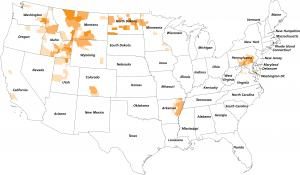
After corn and sorghum, barley is the third major feed grain crop produced in the United States. Production is concentrated in the Northern Plains states and the Pacific Northwest. Between 1999 and 2003, an average of 2 million hectares were planted to barley in the United States. Although this represents less than 2 percent of the total crop area in the country, the United States is the eigth-largest barley producing country in the world. Barley is produced in areas of the United States where the growing season is relatively short and climatic conditions cool and dry.
World Barley Production:

Barley is grown in significant quantity in many places around the world. Like wheat in the western world and rice in the eastern world, barley production, because of its importance in malt beverages, is often a cultural, rather than economic phenomenon.
In Europe, in particular, this has resulted in a decades long subsidy of barley and malt production so that today the European Union is currently the largest exporter of barley and malt. U.S. exports had been substantial prior to the 1980s, when the effect of European subsidies began to be felt and U.S. producers lost market share.
World Barley Exports:

Though the United States produces only 3-5 percent of the 200 million metric tons (7-8 billion bushels) of world barley output, the U.S. is consistently one of the top 10 world barley exporters.
Japan, Canada and Mexico are the largest importers of the world's barley. Japan imports barley for both feed and malt production. A significant and growing percentage of world and U.S. exports is in the form of malt. Japan and Mexico consistently remain as top customers for U.S. barley.
Top U.S. Barley Customers:
For further information contact:
Idaho Barley Commission 1199 Main Street, Suite G Boise, ID 83702-5630 Tel: 1-208-334-2090 Fax: 1-208-334-2335 Website: www.idahobarley.org
Montana Wheat and Barley Comittee P.O. Box 3024 Great Falls, MT 59403-3024 Tel: 1-406-761-7732 Fax: 1-406-761-7851 Website: www.agr.state.mt.us
National Barley Growers Association 821 West State Street Boise, ID 83702-5832 Tel: 1-208-334-2090 Fax: 1-208-334-2335 Website: www.nationalbarley.com
National Barley Foods Council 905 West Riverside, Suite 501 Spokane, WA 99201 Tel: 1-509-456-4400 Fax: 1-509-456-2807 E-mail:
This e-mail address is being protected from spambots. You need JavaScript enabled to view it
Website: www.barleyfoods.org
North Dakota Barley Council 505 40th St SW, Suite E Fargo, ND 58103 Tel: 1-701-239-7200 Fax: 1-701-239-7280 E-mail:
This e-mail address is being protected from spambots. You need JavaScript enabled to view it
Website: www.ndbarley.net/
American Malting Barley Association 740 North Plankinton Avenue, Suite 830 Milwaukee, WI 53203 Tel: 1-414-272-4640 Fax: 1-414-272-4631 E-mail:
This e-mail address is being protected from spambots. You need JavaScript enabled to view it
Website: www.ambainc.org
Washington Barley Commission 905 West Riverside Avenue, Suite 501 Spokane, WA 99201 Tel: 1-509-456-4400 Fax: 1-509-456-2807 Website: www.washingtonbarley.org
|